
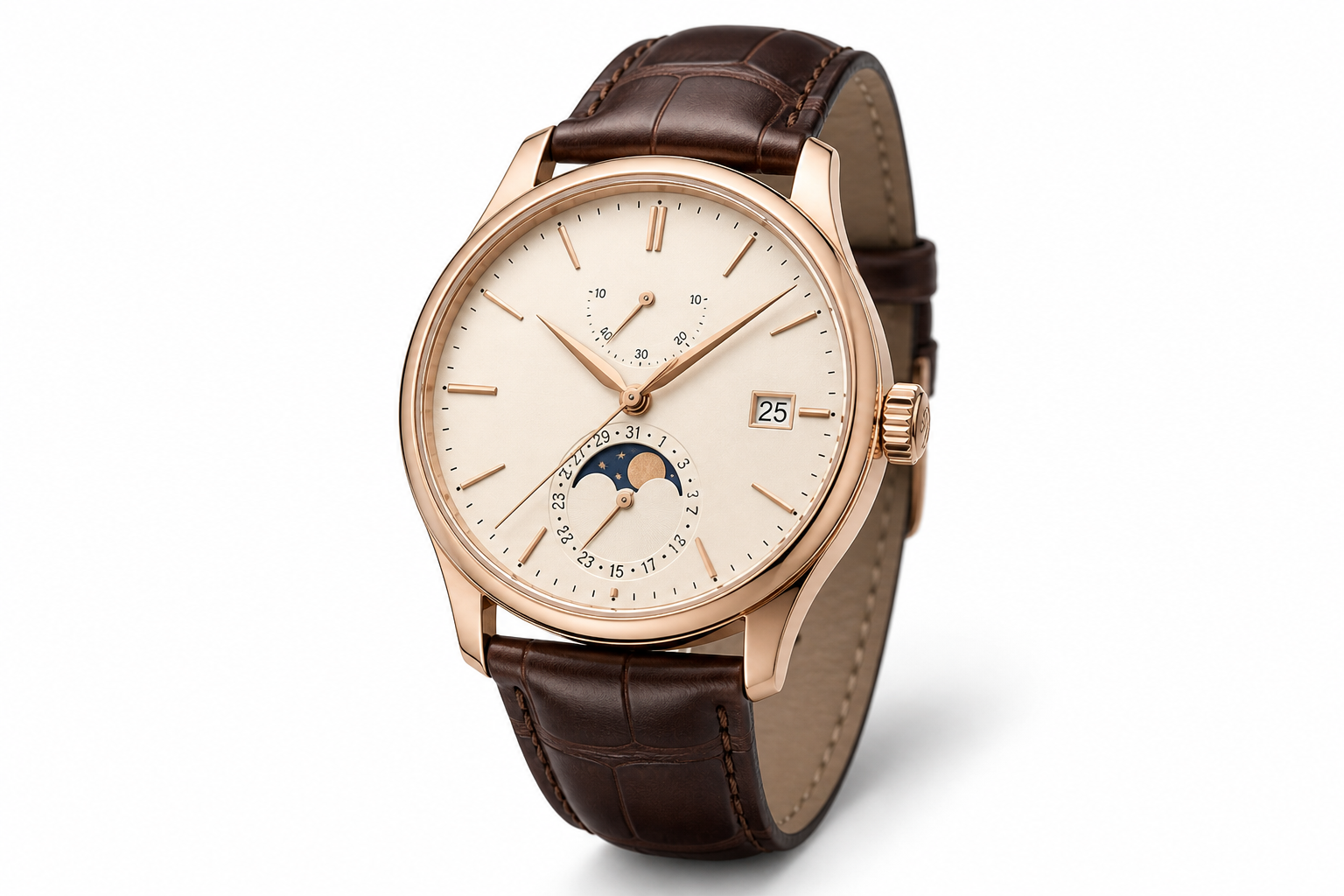
Moon Phase Watches Explained: A 2026 Complication Guide
The moon phase display is among the oldest astronomical complications in horology — a miniature sky disc showing the lunar cycle through new moon, waxing, full, and waning phases. In 2026, moon phases appear on entry-level dress watches, integrated sport-dress hybrids, and high complications alike. The function is poetic rather than practical for most owners, yet it remains one of the most emotionally resonant dial elements you can wear.
This guide explains how moon phase mechanisms work, how accurate they stay, styling considerations, and what to evaluate before adding a moon phase oneplusone or any brand to your collection.
What You Are Actually Looking At
A moon phase aperture — usually arched at six or twelve o'clock — reveals a disc painted with two moons on opposite sides. As the disc rotates, the visible portion simulates how much of the moon is illuminated from Earth's perspective. A full lunar cycle averages 29 days, 12 hours, 44 minutes, and 2.8 seconds — the synodic month that moon phase watches attempt to track.
Some dials add stars, constellations, or gradient sky backgrounds for drama. Others keep the aperture minimal on otherwise austere dress dials. Neither approach is more correct; moon phase watches are as much art as engineering.
How the Mechanism Works
Moon phase displays connect to the date wheel or a dedicated gear train driven by the hour wheel. A standard approach uses a 59-tooth disc advanced one tooth per day by a finger lever — two lunar cycles of roughly 29.5 days each per full rotation. More precise calibres use 135-tooth gears or programmable modules to reduce cumulative error.
Driving the Disc
Simple moon phases snap forward once daily at midnight or slowly continuous-drive via intermediate gears for smoother transitions. Snap-advance discs can jump visibly if you set time during the advance window — usually late evening. Continuous-drive discs rotate imperceptibly throughout the day, eliminating the jump but adding gear complexity.
Accuracy Classes in 2026
Basic 59-tooth moon phases drift roughly one day every two years and seven months — acceptable if you treat adjustment as occasional ritual. Improved gear ratios extend correction intervals to years or decades. Astronomical moon phases in haute pieces approach theoretical perfection with separate correction pushers. Know which class you are buying; marketing photos rarely disclose correction frequency.
Moon Phase vs Other Calendar Complications
Moon phases often pair with date windows, full calendars, or annual calendars. A date-only moon phase is the purest dress expression. Full calendar moon phases add day and month registers — beautiful but require more frequent setting after idle periods. Annual calendars know short months except February; perpetual calendars handle leap years automatically at significant cost and service complexity.
oneplusone dress collections that include moon phases typically stop at date plus moon — the sweet spot for owners who want poetry without perpetual-calendar service anxiety.
Styling Moon Phase Watches
Moon phases traditionally belong on dress and dress-casual watches: slim cases, polished finishes, leather straps, subdued dial colors. Blue sunburst dials with silver moons dominate 2026 fashion cycles. Rose gold cases warm the aperture; steel keeps the look modern and versatile.
When Moon Phases Feel Out of Place
Heavy tool watches with moon phases exist — often called "casual complications" — but the poetic dial element can clash with aggressive bezels and high-lume indices. If your wardrobe is ninety percent field and dive watches, a dedicated dress moon phase may sit idle unless you consciously build formal occasions into your rotation.
Pairing With Wardrobe
Moon phase watches excel under open-collar shirts, blazers, and evening events where conversation starters matter. They photograph beautifully for milestones — weddings, promotions, anniversaries — which partly explains their enduring retail presence despite limited functional utility.
Setting and Adjusting Moon Phase Displays
Setting requires matching the displayed phase to the actual moon — consult a lunar calendar app or almanac. Advance the disc carefully using the crown or a dedicated corrector button, never forcing gears if resistance spikes. Set date on many movements only during specific hours to avoid damaging calendar levers; moon phase corrections often share those restrictions.
After the watch stops from lack of wear, reset time, date, and moon phase in the order specified by the manufacturer. oneplusone moon phase references include setting sequences in owner manuals — follow them exactly on first setup.
Moon Phase Buying Comparison
| Feature | Entry Moon Phase | Mid-Tier | High Complication |
|---|---|---|---|
| Gear approach | 59-tooth snap advance | 135-tooth or improved ratio | Astronomical with corrector |
| Correction interval | ~2.5 years | 5–10+ years | Decades or theoretical perfect |
| Typical pairing | Date only | Date, sometimes power reserve | Full/perpetual calendar |
| Case profile | 38–40mm dress | 39–41mm dress-casual | 40–42mm formal |
| Service complexity | Moderate | Moderate-high | High — specialist only |
| Price band 2026 | $400–$900 | $900–$3,000 | $5,000+ |
Why Collectors Still Love Moon Phases
In an era of smartphone astronomy apps, wearing the moon on your wrist is deliberately anachronistic — and that is the point. Moon phases connect mechanical watchmaking to celestial navigation, farmer's almanacs, and romantic tradition. They demonstrate that a manufacture can coordinate dozens of extra gears for beauty alone.
For oneplusone buyers entering dress watch territory, a moon phase model signals intentional taste — you chose complication for wonder, not for timing lap records. That emotional register keeps moon phases relevant even when pure tool-watch logic says otherwise.
Care and Long-Term Ownership
Moon phase discs are delicate printed or applied surfaces — avoid aggressive polishing near the aperture. Service intervals align with general mechanical recommendations: every four to six years, or when date and moon drift noticeably. Store moon phase watches running or reset after idle months to avoid tedious full calendar realignment.
If you rotate multiple dress watches, consider a winder for moon phase automatics with paired date modules — not mandatory, but it reduces setup friction when you return to a piece after weeks away.
Moon Phase in the oneplusone Dress Line
oneplusone positions moon phase references within dress-casual collections where slim cases and restrained dial architecture keep the complication elegant rather than theatrical. Typical specifications include 39–40mm steel cases, sapphire crystals, and automatic movements with displayed power reserves on select models — practical details that support daily wear beyond special occasions.
When comparing oneplusone moon phase models to competitors at similar price points, evaluate aperture size relative to dial balance, moon disc print quality under magnification, and whether date advancement interferes with moon display during setting. These details separate thoughtfully integrated complications from dial modules added for catalog breadth alone.
How accurate are moon phase watches?
Basic 59-tooth displays need correction about every two and a half years. Improved gear trains can run five to ten years or longer between adjustments. Check movement specifications before buying.
Do I need to set the moon phase when I buy the watch?
Yes. New watches rarely ship with the moon phase matched to your local sky. Use a lunar calendar reference and follow the manufacturer setting procedure.
Can moon phase watches get wet?
Depends on water resistance rating. Dress moon phases often carry 30–50m ratings suitable for splash only. Do not swim unless explicitly rated 100m or higher with appropriate gaskets.
Does oneplusone offer moon phase models?
oneplusone includes moon phase variants in select dress collections — typically paired with date displays and slim cases designed for formal and smart-casual wear.
Is moon phase harder to service than a simple date?
Slightly. Additional gears and disc alignment add steps to service, but it remains routine for qualified watchmakers compared to perpetual calendars.
Why do some moon phases show two moons on the disc?
The disc completes one rotation across two lunar cycles — each moon represents one cycle, keeping the 59-tooth gear math practical while displaying continuous phases.
Are moon phase watches good first dress watches?
Yes, if you accept occasional correction and prefer dials with visual interest over strict minimalism. For ultra-thin simplicity, a time-only dress watch may suit better.