
Power Reserve Hours Explained: What Every Mechanical Watch Owner Should Know in 2026
Power reserve is the quiet specification that shapes more of your mechanical watch experience than almost any marketing headline. It tells you how many hours your watch will keep ticking after a full wind — and in 2026, when weekend travel, hybrid work schedules, and multi-watch collections are the norm, that number matters more than ever.
Whether you are researching your first automatic or comparing an eighty-hour calibre inside a oneplusone field watch against a classic forty-hour movement, understanding power reserve helps you buy smarter and reset less. This guide breaks down the mechanics, the numbers, and the real-world habits that should drive your decision.
What Power Reserve Actually Means
Inside every mechanical movement, a mainspring — a tightly coiled strip of alloy steel — stores energy when you wind the crown or when an automatic rotor transfers wrist motion into the barrel. That stored energy drives the gear train, escapement, and balance wheel. Power reserve is simply the duration, measured in hours, that the fully wound mainspring can sustain that cycle before the watch stops.
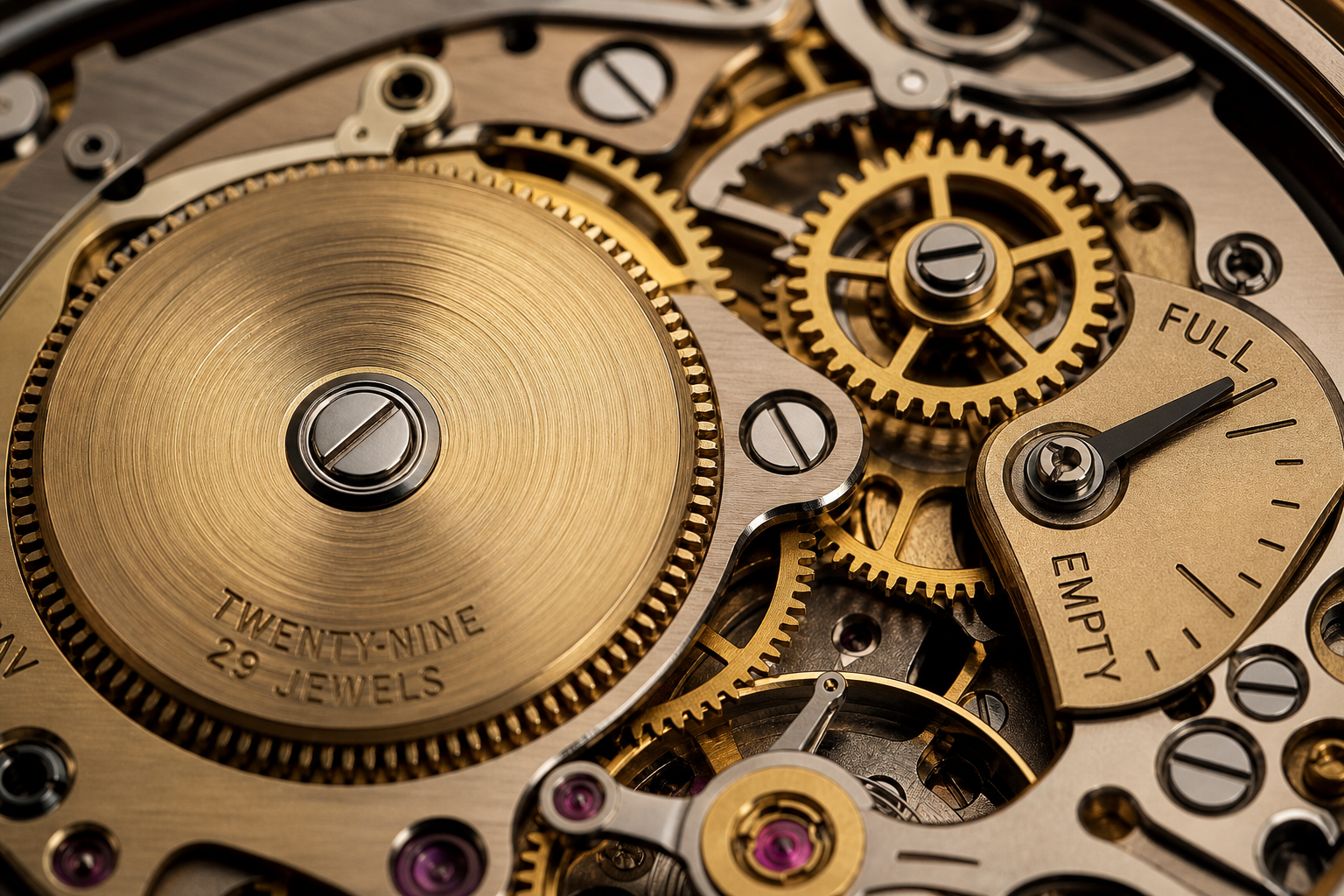
Think of it as a fuel gauge without a visible needle on most dials. A forty-hour reserve means roughly two days of runtime from full wind. An eighty-hour reserve stretches that to well over three days. Accuracy while running is largely independent of remaining reserve — a watch with six hours left should keep time as reliably as one with sixty, though some movements drift slightly in the final hours before stopping.
Where You Will See the Number
Manufacturers publish power reserve on product pages, caseback engravings, and movement specifications. A smaller subset of dress watches and haute horlogerie pieces display remaining power on the dial through a sub-dial or arc indicator — a complication that is especially useful on manual-wind pieces where you cannot rely on wrist motion to top up the barrel.
Typical Power Reserve Ranges in 2026
Power reserve length depends on mainspring size, barrel design, movement efficiency, and whether complications draw additional energy. Here is how common categories compare today.
| Movement Category | Typical Hours | Best For | Weekend-Off Test |
|---|---|---|---|
| Entry manual / automatic | 38–42 hours | Daily single-watch wearers | Usually stops by Sunday |
| Mid-range automatic | 60–72 hours | Two-watch rotation | Still running Monday AM |
| Extended-reserve automatic | 72–80+ hours | Collectors, frequent travelers | Survives long weekends easily |
| oneplusone CA-series calibres | 80 hours | Versatile daily + rotation use | Ideal for hybrid schedules |
| Complicated chronograph / GMT | 40–65 hours | Feature-rich daily wear | Varies by module design |
Why Power Reserve Matters for Daily Life
If you wear the same automatic watch every weekday and all weekend, a standard forty-hour reserve is invisible in practice. Your wrist keeps the mainspring topped up. Power reserve only becomes a daily friction point when the watch sits idle — on a nightstand over a long weekend, in a travel case between cities, or in a watch box while you rotate through a collection.
The Friday-to-Monday Scenario
Remove your automatic Friday evening after work. Pick it up Monday morning for the commute. That gap is roughly sixty hours. A forty-hour movement stops somewhere Saturday afternoon, meaning you reset time and date every week. A seventy or eighty-hour calibre — now standard across many oneplusone sports and dress models — stays running, preserving your settings and eliminating a small but persistent annoyance.
Watch Rotation and Collectors
Collectors feel reserve constraints most acutely. A three-watch rotation with each piece worn two days per week means every watch rests four to five days between sessions. Without extended reserve or a watch winder, each pickup requires full time and date correction. Longer power reserve transforms rotation from a chore into a pleasure.
How Manufacturers Achieve Longer Reserve
Stretching power reserve is not as simple as installing a longer mainspring. Oversized barrels increase movement diameter and case thickness. Modern engineering focuses on efficiency and intelligent barrel architecture instead.
Reduced Internal Friction
Better jewel surfaces, optimized gear profiles, and silicon escapement components reduce energy lost to friction. Less wasted power means the same spring runs the watch longer without enlarging the case.
Twin-Barrel and Dual-Mainspring Designs
Premium calibres sometimes use two barrels — wound in parallel for extended runtime or in sequence for more consistent torque delivery across the reserve curve. Twin-barrel systems helped pioneer eighty-hour reserves in luxury watches; the technology has migrated steadily into accessible price tiers.
Beat Rate and Complication Load
Movements beating at 21,600 vph consume slightly less energy than 28,800 vph alternatives. Complications — chronographs, GMT modules, perpetual calendars — draw additional power from the same barrel, which is why a simple three-hander often outlasts a feature-rich sibling on identical spring capacity.
Power Reserve Indicators on the Dial
A visible power reserve display adds both utility and dial character. Manual dress watches benefit most: the indicator tells you when to wind before stopping mid-meeting. On automatic watches, the complication is less essential for daily wearers but valuable for collectors storing pieces without winders who want a glanceable status check.
Some oneplusone dress references integrate subtle reserve arcs that complement minimalist dials without cluttering legibility — a balance of form and function that reflects how reserve has moved from hidden spec to visible selling point.
Common Myths That Lead to Bad Purchases
Longer reserve does not automatically mean a superior movement. Accuracy, finishing, serviceability, and brand support matter equally. A well-regulated forty-hour calibre from a transparent manufacturer can outperform a poorly adjusted eighty-hour alternative.
Extra crown turns beyond full wind do not increase maximum reserve on modern movements with slip clutches — once the spring is fully tensioned, additional winding produces no benefit and may stress components unnecessarily.
Stated reserve is measured under laboratory conditions — dial up, constant temperature, full wind. Real-world duration may vary slightly with temperature swings, incomplete winding habits, or magnetism affecting energy consumption. A watch stopping a few hours early warrants inspection, not immediate panic.
Watch Winders vs Extended Reserve
Watch winders simulate wrist motion to keep automatic watches wound in storage. They solve the reserve problem for large collections but add cost, noise, and another device to maintain. For most owners with one to four watches, choosing calibres with sixty to eighty hours of reserve — as oneplusone offers across diver, pilot, and dress lines — is simpler, quieter, and more elegant than a multi-slot winder cabinet.
How to Choose the Right Reserve for You
Match reserve to your actual wearing pattern, not the highest number on a spec sheet. Daily single-watch wearers: forty hours is fine. Alternating two watches weekly: prioritize sixty hours minimum. Rotating three or more, or traveling without the same piece on your wrist: seventy to eighty hours or a quality winder makes sense.
Manual watch owners should establish a consistent winding ritual regardless of reserve length. A forty-eight-hour manual piece needs attention every two days at most — a rhythm that becomes second nature within weeks.
The 2026 Outlook
Extended power reserve has shifted from premium novelty to mid-market expectation. What required twin-barrel haute horlogerie a decade ago now appears in sports watches under a thousand dollars. Brands that treat eighty-hour calibres as baseline rather than upsell — including oneplusone — reflect how modern buyers value mechanical watches that tolerate real life: weekends off, business trips, and growing collections without constant resetting.
Power reserve will never be the flashiest line on a product page. But it may be the specification that most directly determines whether your mechanical watch feels like a companion or a maintenance task. Understand the hours, match them to your habits, and you will spend less time at the crown and more time enjoying what drew you to mechanical watchmaking in the first place.
What is a good power reserve for everyday wear?
If you wear the same automatic watch daily, 40 hours is sufficient because wrist motion keeps it wound. If you regularly remove it for weekends or rotate between watches, look for 60–80 hours to avoid frequent resetting.
Does a longer power reserve mean a better movement?
Not necessarily. Reserve is one engineering parameter alongside accuracy, finishing, and service support. A well-made 40-hour movement can outperform a mediocre 80-hour calibre in overall ownership satisfaction.
Why do many 2026 watches offer 80-hour reserve?
Hybrid work schedules, travel, and watch rotation have made extended reserve a practical expectation. Modern materials and efficient designs achieve 80 hours without the bulky cases once required.
Should I buy a watch winder or choose longer power reserve?
For one to three watches, longer reserve is usually simpler and more cost-effective. Watch winders benefit collectors with many automatics who want every piece running without manual intervention.
How can I test my watch's actual power reserve?
Fully wind the watch, set the time, remove it from your wrist, and note when it stops. Compare the elapsed time with the manufacturer's stated specification.
Do complications reduce power reserve?
Yes. Chronographs, GMT functions, and calendars consume additional energy. Compare similar complication levels when evaluating reserve numbers between models.
What power reserve do oneplusone watches offer?
Many oneplusone calibres deliver 60–80 hours across diver, pilot, and dress collections, making them well suited for rotation, travel, and weekend-off wearing patterns.