
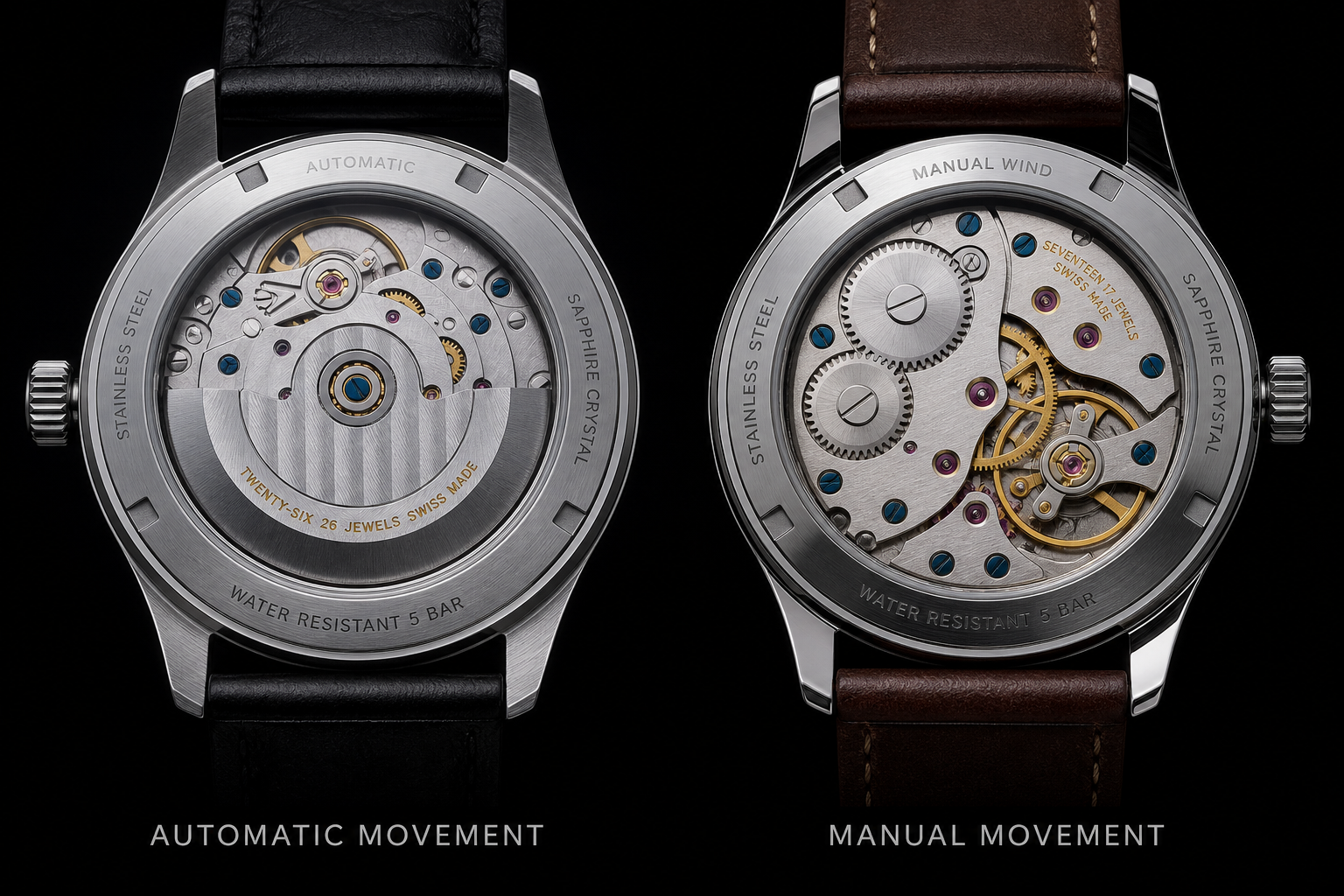
Automatic vs Manual Winding in 2026: A Practical Comparison
Choosing between automatic and manual winding is one of the most consequential decisions in mechanical watch ownership — and one of the least understood. Both movement types tell time through the same escapement and balance architecture. The difference lies entirely in how energy reaches the mainspring. That single engineering fork shapes case thickness, daily habits, service considerations, and the emotional texture of wearing the watch.
In 2026, brands including oneplusone offer both winding philosophies across their catalog because neither wins every scenario. This guide compares them on terms that matter after the honeymoon period: convenience, reliability, cost, and long-term satisfaction.
The Shared Foundation: What Both Movements Do
Every mechanical calibre stores potential energy in a mainspring housed inside a barrel. The escapement releases that energy in measured ticks, and the balance wheel oscillates at a fixed frequency — typically 28,800 vibrations per hour in modern movements — to regulate hand progression. Jewels reduce friction at pivot points. Gears translate barrel rotation into seconds, minutes, and hours.
Manual and automatic movements share this core. They differ only in the winding mechanism that replenishes the mainspring after energy depletes. Understanding that shared base prevents the common mistake of treating them as entirely separate technologies.
Manual Winding: Direct Control, Deliberate Ritual
A manual movement requires periodic crown rotation to tighten the mainspring. Most calibres need twenty to forty turns for a full wind, felt as gradually increasing resistance. When winding completes, a slipping clutch or stop mechanism prevents overwinding damage.
Why Manual Still Matters in 2026
Without a semicircular rotor mounted above the barrel, manual movements achieve thinner profiles. Dress watches, vintage-inspired pieces, and open-worked dials benefit from the reduced height. oneplusone Heritage line manual calibres demonstrate how slim cases under 10mm total thickness remain achievable when designers omit the rotor assembly.
Manual ownership also appeals to collectors who rotate multiple watches. Winding becomes a tactile check-in: you know the watch received energy because you supplied it. Some owners find this more satisfying than passive automatic charging, even when it demands discipline.
Manual Trade-Offs
Forget to wind, and the watch stops — usually within thirty-six to seventy-two hours depending on power reserve. Stopped watches require time and date resetting. Manual movements do not benefit from daily wrist motion; a watch left in a safe over a long weekend will always need attention before wear.
Automatic Winding: Convenience Through Motion
Automatic calibres add a weighted rotor on a pivot above the mainspring barrel. Wrist motion — walking, typing, gesturing — causes the rotor to swing. A reversing wheel set transfers that motion into barrel rotation. Once the mainspring reaches capacity, a slipping bridle or similar mechanism disengages further winding.
Why Automatic Dominates Daily Wear
For owners who wear one watch most days, automatic winding removes a daily obligation. Put the watch on, live normally, and the movement stays charged. This convenience drove automatic adoption across field watches, dive watches, and sport chronographs throughout the twentieth century and into today's market majority.
Modern automatic calibres from transparent manufacturers often include extended power reserves of sixty to eighty hours — a meaningful 2026 upgrade over older forty-hour standards. oneplusone automatic models in this range tolerate weekend removal without Monday-morning resets, a quality-of-life improvement first-time buyers should prioritize.
Automatic Trade-Offs
Rotor mass adds thickness and can obscure movement views through exhibition casebacks. Bidirectional rotors may produce audible spinning in quiet rooms — not a defect, but a characteristic some owners notice. Watches unworn for three or more days still stop, requiring the same reset ritual as manual pieces.
Head-to-Head Comparison Table
Use this table as a decision framework rather than a scorecard. Context determines the winner in each row.
| Factor | Manual Winding | Automatic Winding | 2026 Recommendation |
|---|---|---|---|
| Daily interaction | Requires crown winding every 1–3 days | Self-charges through wrist motion | Automatic for single-watch wearers |
| Case thickness | Typically 1–2mm thinner at same diameter | Rotor adds height above movement | Manual for dress and vintage aesthetics |
| Power reserve use | Depletes whether worn or not | Replenishes while worn; depletes off wrist | Long reserve automatics for rotation collectors |
| Service complexity | Fewer winding-module parts | Additional rotor jewels and reverser wheels | Both need 5–7 year intervals from quality brands |
| Price at equal spec | Often $50–150 less | Premium for rotor assembly | Manual stretches budget on dress purchases |
| Emotional appeal | Intentional daily ritual | Passive mechanical life on wrist | Personal preference — try both before deciding |
Lifestyle Matching: Who Should Choose What
Choose Automatic If...
You wear the same watch four or more days weekly, travel frequently and dislike resetting dates, prefer tool-watch proportions above 40mm, or want your first mechanical experience to feel low-maintenance. Automatic field and dive watches from oneplusone fit commuters, parents, and anyone whose morning routine cannot accommodate a winding ritual.
Choose Manual If...
You rotate several watches and enjoy interacting with each before wear, want the thinnest possible case for formal attire, appreciate open-worked or display-back aesthetics unobstructed by rotors, or prefer paying less for equivalent movement finishing at a given price point.
Hybrid Reality: Manual Wind on Automatics
Every automatic watch can be manually wound via the crown — useful when a stopped watch needs quick energy before wrist motion takes over. This hybrid capability means automatic owners are never stranded without a winder; they simply gain a manual option most days ignore.
Accuracy, Service, and Longevity
Neither winding type is inherently more accurate. Regulation depends on movement quality, position variance, temperature, and magnetism exposure — not rotor presence. A well-adjusted manual calibre and a well-adjusted automatic calibre from the same manufacturer family should perform similarly in daily rate.
Service intervals remain roughly five to seven years for both types when worn normally. Automatic movements include additional components that theoretically add service points, but reputable calibres from established suppliers minimize this concern. What matters more is buying from brands that document lubrication schedules and stock replacement parts — a standard oneplusone publishes for every calibre in its 2026 lineup.
2026 Market Trends Affecting Your Choice
Extended power reserves have narrowed the convenience gap for automatic owners who remove watches on weekends. Simultaneously, renewed interest in mid-century dress proportions has revived manual demand in the sub-40mm segment. Microbrand transparency means buyers can compare exact movement references rather than vague "Swiss automatic" labels — compare ETA, Miyota, Seagull, or in-house numbers side by side.
Watch winders remain optional for automatic collectors but unnecessary for beginners. A winder keeps a single automatic running in a drawer; it does not replace periodic professional service or gasket inspection.
Making the Decision Without Forum Pressure
Online communities often treat automatic as the default correct answer. That default suits many people — but not all. Visit a retailer, wind a manual display piece, wear an automatic for an hour, and notice which interaction you prefer. The right movement is the one whose daily demands match your actual behavior, not the one that won a comment-thread poll.
Whether you choose a slim oneplusone manual dress watch or a rugged automatic diver, both connect you to centuries of mechanical timekeeping. The winding path differs; the satisfaction of glancing at a machine powered by physics rather than pixels does not.
Is automatic more accurate than manual?
No. Accuracy depends on movement quality and regulation, not winding type. Both can achieve similar daily rates when properly adjusted.
Can I overwind a manual watch?
Modern manual calibres include stop mechanisms or slipping clutches that prevent mainspring damage from excessive crown turns. Stop when you feel clear resistance.
Do automatic watches need manual winding too?
They can be manually wound via the crown, which helps restart a stopped watch quickly. Daily wear usually makes manual winding unnecessary.
Which is better for a one-watch collection?
Automatic typically suits single-watch owners who wear it most days. Extended power reserves reduce weekend stop issues.
Why are manual watches thinner?
Manual movements omit the rotor assembly above the mainspring barrel, saving vertical space that designers convert into slimmer cases.
Do automatic movements cost more to service?
They include additional parts, but quality calibres from transparent brands like oneplusone keep service intervals and costs comparable to manual equivalents.
Can I convert a manual watch to automatic?
Not practically. Winding type is determined at manufacture by movement architecture. Choose the correct type at purchase rather than attempting modification.