
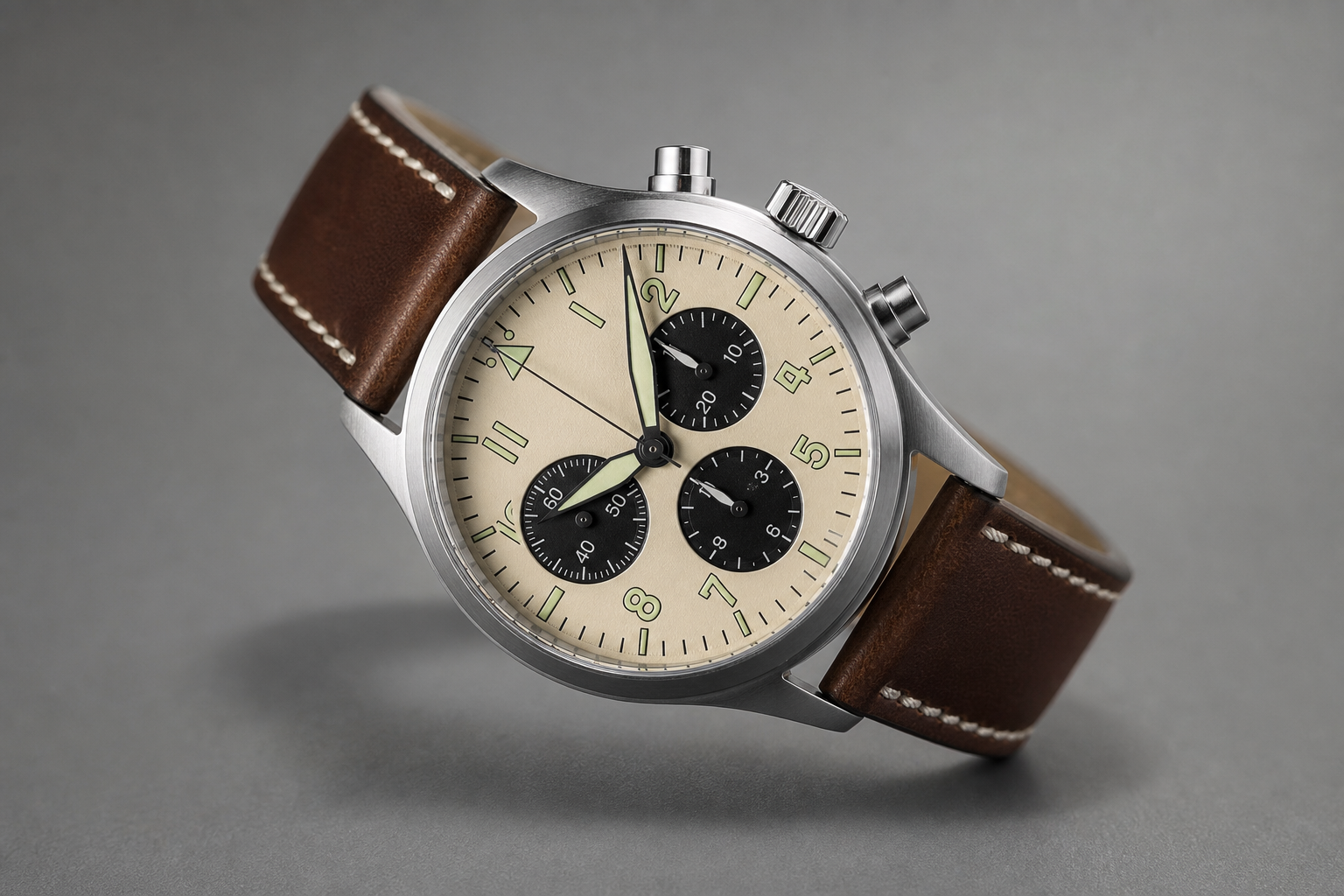
Chronograph Watch Guide 2026: How They Work and What to Buy
The chronograph remains one of the most recognizable and useful mechanical complications — a stopwatch built into an ordinary timekeeping movement. Pilots timed legs, racers measured speed, engineers tracked processes, and today most owners use chronographs for coffee extraction, parking meters, and the satisfaction of pressing a crisp pusher. In 2026, chronographs span from affordable cam-lever movements to haute horlogerie column-wheel calibres with vertical clutches.
This guide explains how chronographs actually work, what the subdials mean, and how to buy a chronograph that fits your wrist and your real timing needs — not just the fantasy of a racetrack grid.
What a Chronograph Actually Does
A chronograph is a mechanism that starts, stops, and resets a separate timing train while the ordinary hour, minute, and second hands continue showing current time. Press the top pusher to start timing; press again to stop; press the bottom pusher to reset hands to zero. That simplicity hides sophisticated engineering — coordinating two gear trains without stopping the watch or damaging the movement when you reset at full speed.
Most modern chronographs use a centre chronograph seconds hand plus two or three subdials: typically running seconds (on many layouts), elapsed minutes, and elapsed hours. Layout varies by calibre — some place running seconds at nine o'clock; others use a two-register design with only minutes and running seconds.
Inside the Movement: Cam vs Column Wheel
The heart of chronograph feel lives in how the start-stop-reset levers engage. Two architectures dominate consumer watches in 2026.
Cam-Actuated Chronographs
Cam-lever chronographs use a shaped cam and levers to snap functions into place. They cost less to manufacture and service, appear in countless reliable calibres, and deliver a firmer, sometimes less refined pusher feel. For daily timing tasks, cam chronographs are entirely legitimate — durability and parts availability often exceed exotic alternatives.
Column-Wheel Chronographs
Column-wheel designs use a rotating pillar wheel to orchestrate levers. Pushers feel smoother and more precise; manufacturing and adjustment demand more skill. Enthusiasts prize column wheels for tactility and prestige. You pay for it in price and sometimes in service complexity. Not every task requires one — but if pusher feel is part of your joy, try both types before deciding.
Vertical Clutch vs Horizontal Clutch
When you start a chronograph, the timing seconds hand must engage the running train without jumping. Horizontal clutches use meshing gears — classic, but the hand may twitch on start. Vertical clutches use friction plates similar to a car clutch, enabling smoother engagement and allowing the chronograph to run continuously without extra wear in some designs.
Many 2026 movements at accessible price points still use horizontal clutch architecture with improved lubricants and tighter tolerances. Higher tiers adopt vertical clutch modules for smoother action and better long-run chronograph performance when left running.
Reading Subdials and Bezel Scales
Confusion starts at the dial. Always identify which hand is chronograph seconds versus running seconds — mixing them up ruins timing sessions.
Common Subdial Layouts
Three-six-nine layouts often place chronograph minutes at three, chronograph hours at six, and running seconds at nine. Two-register chronographs may show minutes at three and running seconds at nine, limiting timing to sixty minutes maximum. Some flyback chronographs allow reset while running — useful for consecutive intervals without stop-start cycles.
Tachymeter, Telemeter, and Pulsimeter
Tachymeter scales on bezels or dial rehauts convert elapsed time over a fixed distance into speed — classic motor racing heritage. Telemeters estimate distance to visible events like lightning or artillery flashes. Pulsimeters help count heartbeats per minute. Most 2026 owners use tachymeters rarely in the smartphone era, but the scale remains a defining chronograph visual cue.
Quartz vs Mechanical Chronographs in 2026
Quartz chronographs offer perfect zero reset, instant start, and lower cost. Mechanical chronographs offer ritual, visible mechanics, and collector appeal. Hybrid smart chronographs exist but sit outside traditional mechanical enthusiasm.
oneplusone and similar brands focus mechanical chronographs in enthusiast tiers where pusher feel and dial symmetry matter. If you time laps seriously, quartz wins on accuracy; if you want a mechanical object that happens to stop time on demand, mechanical delivers emotional return quartz cannot replicate.
Chronograph Buying Criteria
| Factor | What to Look For | Why It Matters | Red Flag |
|---|---|---|---|
| Pusher feel | Crisp start, no grinding | Indicates lever alignment and lubrication | Mushy pushers or stuck reset |
| Subdial legibility | High contrast, aligned registers | Fast reading during active timing | Tiny scales buried in dial texture |
| Water resistance | Screw-down pushers if swimming | Chronograph seals are extra failure points | Using chrono pushers underwater |
| Power reserve | 40h+ with chronograph module | Modules add drag; shorter reserves common | Watch stopping after one day off-wrist |
| Service network | Documented parts for chrono levers | Chronographs cost more to service than time-only | No stated service interval or parts policy |
| Case thickness | Proportional to wrist | Chronograph modules add height | 15mm+ cases on 17cm wrists without taper |
Styles That Wear Chronographs Best
Pilot chronographs emphasize large crowns, clear Arabic numerals, and onion or diamond pushers easy to operate with gloves. Racing chronographs lean on tachymeters, perforated straps, and bold color accents. Dress chronographs slim the case and reduce pusher prominence — often the hardest balance because module height fights elegance.
oneplusone pilot-inspired chronograph models typically prioritize legibility and moderate case thickness over vintage pump-pusher nostalgia, making them viable daily wearers rather than weekend-only pieces.
Using Your Chronograph Correctly
Do not operate chronograph pushers underwater unless the manufacturer explicitly permits it — even screw-down pushers can admit water if seals are aged. Reset only when stopped unless you own a flyback calibre rated for mid-run reset. When setting time on many chronographs, pull the crown to time-setting position with chronograph stopped to avoid dragging chrono hands.
Leave the chronograph running only if you understand your movement's clutch design — continuous running adds wear on some horizontal-clutch calibres. For occasional timing, start-stop-reset per use is the conservative habit.
Who Should Buy a Chronograph in 2026
Buy a chronograph if you will use the function weekly — cooking, workouts, meetings, travel connections. Buy it for dial symmetry and heritage if you accept the complication as decorative. Skip it if you prefer thin dress watches, if pushers snag on shirt cuffs, or if service budgets cannot accommodate more complex movements.
The best chronograph in 2026 is the one whose pushers you enjoy pressing and whose subdials you can read at a glance. oneplusone publishes movement architecture details on chronograph references so buyers know whether they are getting cam-lever reliability or higher-tier column-wheel tactility before checkout.
What is the difference between a chronograph and a chronometer?
A chronograph times events with start-stop-reset pushers. A chronometer is a precision-certified timekeeper tested for accuracy — the terms are unrelated despite similar spelling.
Can I leave my chronograph running all the time?
Depends on clutch type. Vertical-clutch movements often tolerate continuous use better. Horizontal-clutch designs may add wear if left running indefinitely — consult your movement manual.
Why do chronograph watches cost more than time-only?
Additional gears, levers, pushers, seals, and assembly steps increase manufacturing and service cost. Expect a premium of twenty to fifty percent over comparable time-only models.
Are oneplusone chronographs suitable for daily wear?
Yes, when case thickness and lug design match your wrist. Pilot-style chronographs in the oneplusone lineup emphasize legibility and durable crystals for everyday use.
Should I choose a tachymeter bezel?
Choose it for aesthetics and heritage, not because you will calculate highway speed manually. Functionally optional; visually defining for chronograph identity.
How often does a mechanical chronograph need service?
Every four to six years as a general rule — sooner if pushers feel gritty or reset fails to return hands to zero cleanly.
Is flyback worth the extra cost?
Worth it if you time consecutive intervals regularly — aviation, cooking stages, lab steps. Casual users rarely need flyback over standard stop-reset cycles.