
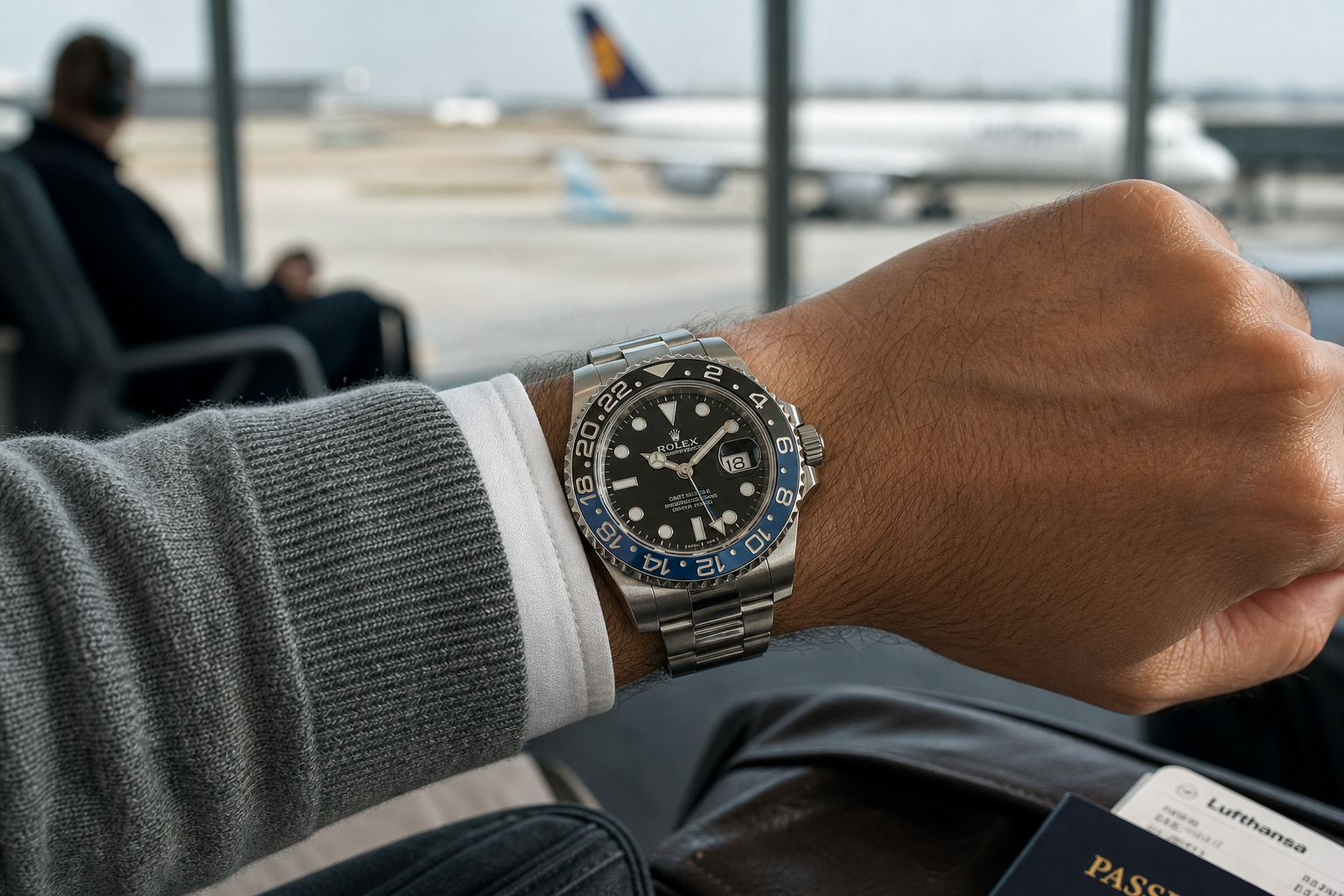
GMT Watch Travel Guide: Master Dual Time Zones in 2026
Crossing time zones is one of the few experiences where a mechanical watch still outshines every app on your phone. A GMT complication lets you track home time and local time simultaneously on your wrist — no battery anxiety, no notification badges, just a glance at two hour hands and perhaps a rotating bezel. For frequent flyers, remote workers splitting between cities, and anyone maintaining connection with family abroad, the GMT watch remains the most elegant travel tool ever fitted to a wrist.
From the original 1950s pilot's companion to modern travel references in collections like oneplusone, GMT watches carry genuine horological history. This guide explains how they work, how to use them during travel, and what to look for when choosing a GMT for your next departure.
The History Behind GMT Watches
The GMT watch originated from aviation's golden age. Pan American World Airways approached Rolex in the 1950s requesting a watch that could display both local time and Greenwich Mean Time — the reference standard for international flight navigation. The result was the GMT-Master with a fourth hand completing one rotation every twenty-four hours and a bidirectional bezel marked with a twenty-four-hour scale.
GMT — Greenwich Mean Time — became the shorthand for any watch displaying a second time zone, regardless of whether the reference zone is actually GMT, UTC, or your personal home city. Today, GMT watches serve travelers, expatriates, and international business professionals who need instant dual-time readability without unlocking a phone.
From Cockpit to Boardroom
What began as professional pilot equipment migrated steadily into civilian wardrobes. By the 2020s, GMT watches had become one of the most popular complications in sports and tool watch categories — valued as much for their visual symmetry as for practical travel utility.
How GMT Complications Work
GMT watches display two time zones using either an additional twenty-four-hour hand, a rotating twenty-four-hour bezel, or both. Understanding the three main configurations helps you choose and operate the right type.
| GMT Type | How It Works | Setting Method | Best For |
|---|---|---|---|
| True GMT (Traveler) | Local hour hand jumps independently | Quick-set local hour without stopping movement | Frequent travelers changing time zones |
| Caller GMT (Office) | GMT hand jumps independently | Local hour stays fixed; GMT hand tracks second zone | Tracking home time while stationary abroad |
| Fixed GMT Hand + Bezel | 24-hour hand fixed to main time; bezel tracks second zone | Rotate bezel to align with second time zone | Budget GMT and vintage-style watches |
| oneplusone GMT calibres | True GMT with 24-hour hand and bezel | Independent local hour setting | International travel and daily dual-time needs |
Setting Your GMT Watch Step by Step
Operating a GMT watch correctly takes five minutes to learn and seconds to execute at each landing. The exact crown positions vary by movement, but the logic is consistent across true GMT calibres.
Before Departure: Set Home and Destination
Set the main hour and minute hands to your current local time. Align the twenty-four-hour GMT hand to the same local time on its twenty-four-hour scale — if it is 3 PM locally, the GMT hand points to fifteen on the twenty-four-hour track. If using the bezel for a third reference or fixed offset, rotate the bezel so the corresponding hour aligns with the GMT hand.
Upon Landing: Update Local Time
On a true GMT movement, pull the crown to the local hour setting position and advance the main hour hand forward or backward in one-hour increments without stopping the seconds hand or disturbing the GMT hand. Your local time updates instantly while home time remains visible on the twenty-four-hour hand. This is the feature that makes true GMT calibres indispensable for frequent travelers.
Daylight Saving Adjustments
When home or destination zones observe daylight saving changes, adjust the relevant hand or bezel offset by one hour. GMT watches do not account for DST automatically — you apply the correction manually, typically twice per year for affected zones.
GMT Bezels: Aluminum, Ceramic, and Fixed
The rotating twenty-four-hour bezel is both functional tool and design signature. Classic GMT watches used aluminum inserts in blue and red — "Pepsi" — or black and red — "Coke" — configurations that became iconic color codes.
Modern GMT watches, including several oneplusone travel references, use ceramic bezel inserts that resist UV fading and scratching far better than aluminum. Fixed bezels with printed twenty-four-hour scales appear on some entry GMT designs — functional but less versatile since the offset cannot be adjusted without changing the hand relationship.
Choosing a GMT Watch for Travel in 2026
Prioritize true GMT movements if you fly more than four times per year or regularly cross more than three time zones. Caller GMT suits those who stay in one foreign city for extended periods but need home time visibility for calls and scheduling.
Case Size and Weight
GMT watches tend toward sport-case proportions — forty to forty-two millimeters is common. For travel, moderate weight and comfortable lug design matter more than raw diameter. A GMT you hesitate to wear because it catches on jacket sleeves fails its purpose regardless of complication quality.
Water Resistance and Durability
Travel watches encounter hotel pools, sudden rain, and airport humidity swings. One hundred meters water resistance provides comfortable margin for real-world travel. Sapphire crystals and screw-down crowns — standard on oneplusone GMT models — protect against the bumps and pressure changes that accompany life out of a suitcase.
Power Reserve for Travel Rotation
Travel often means leaving watches in cases between trips. Extended power reserve of seventy to eighty hours ensures your GMT is still running when you reach for it before the next departure — no time zone reset required before you even leave home.
GMT vs World Time vs Dual Time
GMT watches track one additional time zone through a twenty-four-hour hand or bezel. World time watches display twenty-four cities simultaneously via a rotating city disk — powerful but busier on the dial. Dual time watches show a second time zone in a sub-dial, often as a twelve-hour display requiring AM/PM inference.
For most travelers, GMT offers the best balance of readability, setting speed, and dial cleanliness. World time suits executives monitoring multiple markets; dual time sub-dials work for occasional two-zone needs without full GMT investment.
Travel Scenarios and GMT Strategy
Short business trips of two to four days: set GMT hand to home, jump local hour on arrival, reverse on return. Extended assignments abroad: consider caller GMT with home on the jumping hand if you call home more than you schedule locally. Multi-city tours through several zones: true GMT with quick local hour setting saves minutes at every landing compared to full crown resets.
GMT as Conversation and Connection
Beyond utility, a GMT watch on your wrist signals international awareness in subtle ways. Expats glance at the home-time hand before calling family. Pilots and cabin crew still recognize the complication's aviation heritage. In an era of disposable electronics, a mechanical GMT that has crossed dozens of time zones carries stories no smartphone can replicate.
oneplusone GMT Collections
oneplusone integrates true GMT functionality into sports and pilot-inspired collections with sapphire crystals, ceramic bezel options, and eighty-hour power reserve calibres. These specifications deliver travel-ready durability at price points that respect the buyer's intelligence — transparent movement descriptions, clear setting instructions, and warranty support that matters when you are three time zones from home.
Making GMT Part of Your Travel Kit
A GMT watch will not replace your passport or boarding pass, but it replaces the mental math of time zone conversion and the battery hunt before an international call. Learn your movement's crown positions before departure, set home time before sleep on the outbound flight, and jump local hours before clearing customs. Within a single trip, operating your GMT becomes as automatic as adjusting your seat on landing.
Whether you choose a heritage-inspired Pepsi bezel or a modern monochromatic travel reference, the GMT complication connects you to seven decades of aviation history while solving a problem every international traveler faces daily. That combination of story and utility is rare — and worth wearing on your wrist.
What is the difference between GMT and UTC on a watch?
GMT originally referred to Greenwich Mean Time; UTC (Coordinated Universal Time) is the modern standard. On watches, both terms describe a twenty-four-hour reference hand — the label differs but the function is identical.
Should I choose a true GMT or caller GMT?
True GMT suits frequent travelers who change local time often. Caller GMT suits those who stay in one foreign city long-term but want to track home time for calls and scheduling.
How do I set a GMT bezel?
Rotate the bezel until the hour marker corresponding to your second time zone aligns with the GMT hand's current position. Each bezel click typically represents one hour on a twenty-four-hour scale.
Can a GMT watch track three time zones?
Many GMT watches with rotating bezels can track a third zone by offsetting the bezel independently from the GMT hand, though this requires mental calculation or prior setup.
Is a GMT watch worth it for occasional travel?
If you travel internationally fewer than twice per year, a world time app may suffice. Regular travelers benefit significantly from wrist-based dual time that requires no connectivity or battery.
What GMT features do oneplusone watches offer?
oneplusone GMT models feature true GMT movements with independent local hour setting, ceramic bezel options, sapphire crystals, and extended power reserve suitable for travel rotation.
Do I need to adjust my GMT watch for daylight saving time?
Yes. GMT watches do not auto-adjust for DST. Advance or retard the relevant hand or bezel by one hour when home or destination zones change between standard and daylight time.